Yesterday found us back in London for the day and night. We spent the morning at The Cabinet War Rooms Museum. If you are ever in London, it is really worth a visit.
Friday, July 2, 2010
London for a Day
Yesterday found us back in London for the day and night. We spent the morning at The Cabinet War Rooms Museum. If you are ever in London, it is really worth a visit.
Wednesday, June 30, 2010
Forest of Dean
England? Food?
Tuesday, June 29, 2010
England Winery
Today we went to Three Choirs Winery in Newent, Gloucestershire England. It is the second largest winery in Britain, and as you can see from this photo, it is in a truly beautiful spot.
They grown primarily German grapes because, so they claim, Germany has a similar climate to England (though I would imagine Germany must get more sun and less rain than England does, though I could be wrong).
I admit that I had never heard of any of the varietals: Bacchus; Siegerrebe; Phoenix; Reichensteiner; Madeleine Angevine; Huxelrebe. Bless you.
I cannot emphasize enough what a monumental task it is for them to grow grapes in such a wet and cool climate. From 75 acres under vine, in 2006 (their best year) they harvested 400 tons of grapes. In 2007, a wet year, they were only able to harvest 70 tons. In 2008, another wet year, 80 tons.
They were unable to even offer us a tasting of a red wine, because they just couldn’t harvest enough of those grapes to make one.
They make a nice non-vintage sparkling wine which my friends served at their wedding and it was perfect for a warm summer day; bright and crisp and apple-citrusy.
I was so impressed by the vineyards and the overall production of the place that I was really rooting for the wines before I tasted them. But here is the problem: the wines had almost no nose and almost no taste.
They tasted a bit like white wine which had been watered down. A hint of herbal grassiness and lychee on the nose, but not much else. And I realized that what we were tasting was what this climate is able to produce: waterlogged fruit that has not been able to ripen enough to really produce any real depth or complexity.
It could be that the particular varietals they have chosen produce very light-tasting wines, I don’t know. It will be interesting to get to Germany and try those same varietals and compare.
On the tour she also mentioned that when the vines reach 30 years of age, they get rid of them and re-plant with baby vines. The tour guide stated that the vines when they hit 30 years produce incredible fruit, but that the yields go way down.
In my opinion, herein may lie another of their problems: they are worrying too much about yield and less about quality. Right now, they make one sparkling wine, nine whites, one rose and two reds.
Maybe that's just too many. It seems like if they focused on fewer varietals and kept more of the older vines which are producing superior fruit and then made just one or two whites and reds and really got the best fruit they could, they would be able to make much better wines.
I don’t know anything about winemaking so I might be talking completely out of my ass.
Thoughts????
Monday, June 28, 2010
Bath
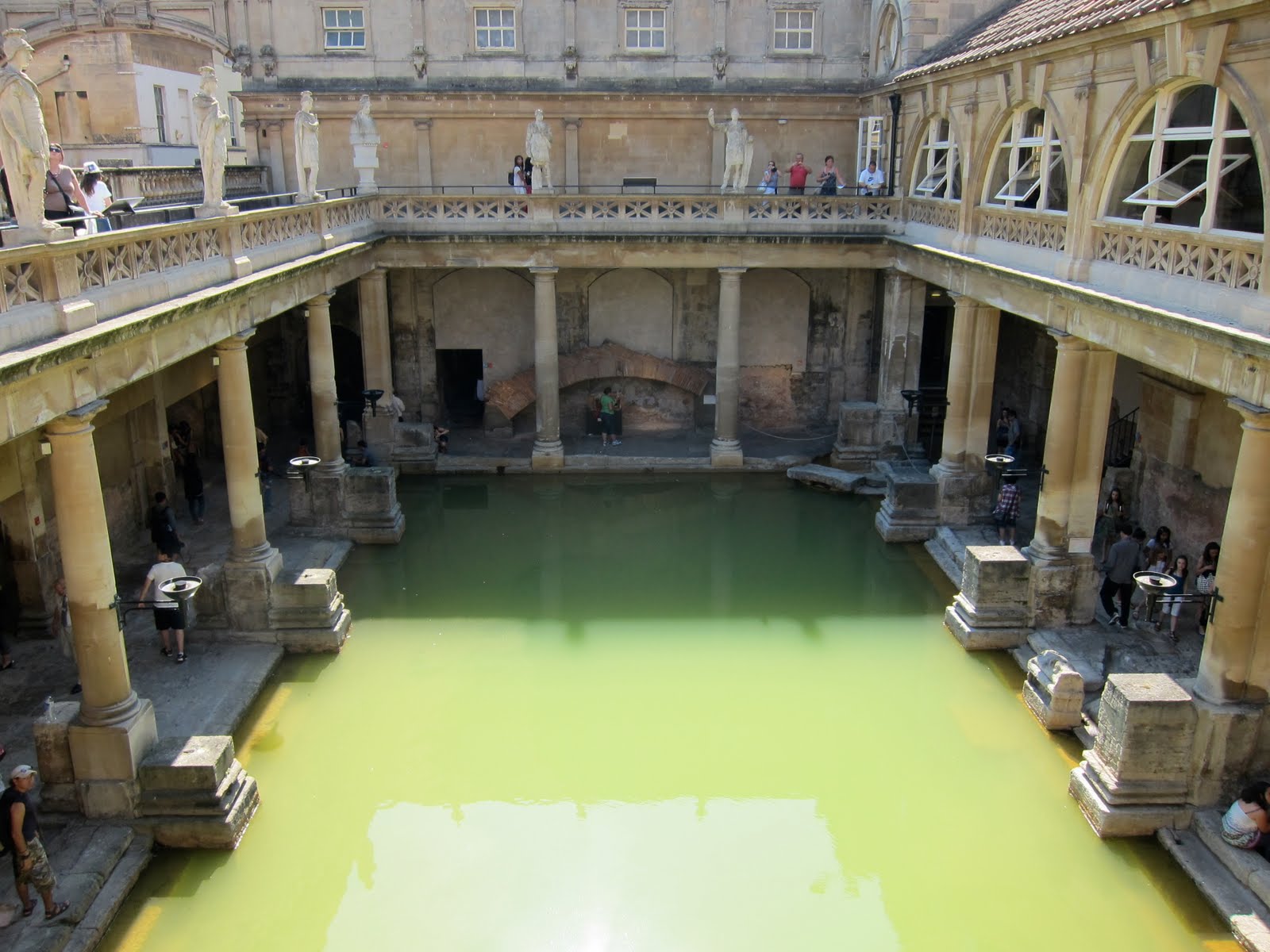
Bath has wonderful shopping and residential areas as well as the beautiful River Avon, but what really makes it special is the Roman bath that is there.
Normally, I don't get too excited over baths; ones I have seen in the past have tended to just be an oblong of old crumbling stone with an area that the plaque tells you was once a changing area and plunge pool, but just looks like a wall that fell over, but these baths today were really amazing.
To begin with, the complex was started in the 1st Century AD, which I have trouble wrapping my head around, and it is enormous. Even today, the excavation is not complete, and they think the bathing complex continues on even further under the street.
The initial impetus for the building of this massive complex was the discovery in the 1st Century AD of this magical spring of water bubbling up, hot from the ground. Believing this was a source directly from the goddess, they erected this amazing spa around it.
No one was allowed to bathe directly in the bubbling pool, but it fed other pools which people could bathe in. This spa contained changing areas, massage rooms, cold and tepid plunge pools, a pool with benches inside it so that people could sit up to their necks in water, a room that was essentially a sauna, a temple, and the main bath, where presumably business was conducted by naked bathers.
I know they had their issues, but those Romans, my goodness they were innovative. They tempered iron and created pipes to direct the flow of water into the different chambers; they created pulleys that made the weight of what was being pulled feel significantly less; they created some system of piping air into one of the pools so that they essentially had a whirlpool; they stacked layers of tiles in different rows and then laid a floor on top of it so that the warmth from the furnace (they created a system of furnaces within the stones) flowed through the spaces between these tile stacks and heated the floor so much that the room essentially became a sauna; they used large round stones with holes in them to vent steam; and they developed a pump room to deliver water to different chambers.
It really was astonishing, as was their belief in the power of this hot water of the goddess to heal and protect. They were unbelievably ahead of their time. This recent movement we have been having to incorporate massage and other more "alternative" therapies into our lives, the Romans already understood. They believed that things like massage, hot water, sweating, cleansing and relaxation were an important and in fact pivotal part of life, one that was spiritual as well as physical.
Of course, they also liked to sacrifice living things in their temples, so I don't want to idealize them too much.
Saturday, June 26, 2010
The Cotswolds!
We are in the Cotswolds in England, and I am in love. This is my new favorite place in this country. It is quaint and beautiful, with sweeping farmland and rolling hillsides, large dark green trees, and charming villages with stone and/or wood houses and buildings, some of which date back to the 1600’s.
Churchbells chime, birds chirp, and (in what I gather is a rare occurance) the sun has been shining for the past week, and continues to do so.
Our hotel, The Close, in the town of Tetbury, has a beautiful walled garden, a four-poster bed in our room, thick drapes to block out the sun, and possibly the longest bathtub I have ever seen. The photo above is of our hotel from it's back garden.
It is, to say the least, wonderful, and relaxing, and we love it so much, we have decided to stay past the wedding weekend for an extra three nights.
Today we explored a wonderful little village called Painswick, nearby there is a supposedly amazing botanical garden, Bath is about 30 miles away, and about a 45 minute drive from here is a vineyard/winery!
I must comment, however, on what I feel to be England’s excessive use of the roundabout. They LOVE the roundabout here. On a 27 mile drive today, we encountered no less than 1400 roundabouts. I kid you not. There are more roundabouts than there are straightaways. I felt like I was on that crazy spinning teacup ride at Disneyland.
Being on the wrong side of the car, on the wrong side of the road, entering and exiting the roundabout from the wrong side just really does your head in.
We cannot have so many roundabouts in the US because, let’s face it, we just couldn’t handle them. We just can’t drive that well.
Here in the UK, people entering the roundabout actually yield to the cars already on it. They really yield-like sometimes they actually even stop. And they don’t enter the roundabout until it there is space for them to do so.
That would NEVER happen in the US. I’ve barely ever seen a car that yielded merging on to the freeway. In the US everyone assumes they have the right of way, and the other cars should just watch out and make way for them.
Growing up there was one roundabout in Newton, and every time you drove on it, you felt as if you were taking your life into your own hands.
Speaking of which, the most insane roundabout I have ever seen is the one around the Arc de Triomphe in Paris. For some inexplicable reason, the drivers who are already on the roundabout must yield to the traffic coming onto it, instead of the other way around.
This leads to masses of cars suddenly slamming on their brakes inches away from the cars that are entering the roundabout. I have never seen anything like it.
Steve’s parents once wound up on that roundabout by mistake, and it was such a disordered mess, they couldn’t figure out how to get off of it and they just drove around and around it for hours. In fact, I think they’re still there.